
Among the common complexities in navigating the healthcare landscape today, prior authorization ranks as one of the top issues burdening the system. While originally intended to serve as a critical safeguard by payers to ensure patients receive safe, affordable, and evidence-based care, the process has been defined by fragmented, manual, and outdated workflows.
For providers and patients, this reality often results in delays, discontinuity in the care delivery process, negative impacts on patient outcomes, and challenges accessing new medications or therapies. Further, providers are faced with increasing, and often manual, administrative processes that contribute to clinician burnout. For payers, increasing regulatory efforts to address the aforementioned pain points have introduced new operational challenges, while the ultimate goal of validating clinical necessity remains a key need for all. And of course, for pharma manufacturers and pharmacies, the barrier to new therapy starts negatively impacts revenue, population penetration, and the ability to maximize evidence of patient outcomes.
In light of the challenges, the industry is in the midst of a fundamental shift from manual workflows to automation and transparency across all constituents. Federal mandates alongside broad stakeholder motivation to standardize the workflow are driving a surge in technology solutions. With AI capabilities driving the speed of re-tooling, these efforts aim to create an efficient, transparent, and modernized approach to prior authorization.
Critical Problems with Traditional Prior Authorization
The prior authorization workflow introduces friction points that have proven inefficient and disruptive to patient care. The reliance on outdated, manual approaches burdens all stakeholders across care delivery processes: patients, providers, pharma / pharmacy, and payers.
- Providers – Administrative Hurdles and Clinician Burnout: For providers, prior authorization is often cited as the primary driver of operational inefficiency and dissatisfaction. The process relies on antiquated workflows, with nearly half of prior authorization requests still submitted by fax or phone. Proprietary and multi-access point payer portals create administrative complexity, as staff must learn varying sets of rules for a single medical procedure depending on the payer. Additionally, coding mismatches introduce further complexity as discrepancies between CPT / HCPCS codes and patient diagnosis codes can trigger auto denials. Without a standardized approach to engagement, the long tail of payers cannot be automated with existing provider resources. Driven by administrative inefficiencies, prior authorization remains a resource-heavy manual process. According to the 2024 American Medical Association (AMA) Prior Authorization Physician Survey, providers and their staff spend over 15 hours a week on documentation alone, a burden that contributes to approximately 90% of clinicians reporting prior authorization as a primary cause of burnout.
- Pharma and Pharmacy – Barriers to Access, Adherence, and Evidence: For pharma manufacturers and pharmacies, the traditional prior authorization process represents a significant barrier to both therapy initiation and long-term medication adherence. These hurdles manifest as lengthy delays at the point of prescription, often leaving patients, providers, and pharmacists in a period of limbo while manual workflows are processed. This administrative friction substantially increases the likelihood of prescription abandonment. For those already receiving therapy, the need for re-authorizations can further disrupt the approval cycle and lead to gaps in medication coverage. These barriers undermine the clinical efficacy of treatment plans and make it increasingly difficult for patients to maintain consistent therapy adherence necessary to achieve optimal health outcomes. Consequently, pharma manufacturers are missing out on additional clinical and/or real-world evidence that can be used to expand payer coverage, improve formulary placement, or support label expansion.
- Patients – Delays, Denials, and Discontinuity: At the end of the day, patients bear the ultimate consequences of an inefficient prior authorization system. Lengthy and manual approval cycles lead to delays, or even denials, in accessing care. Disruptions in treatment are particularly harmful for patients with chronic conditions who require frequent and ongoing medical attention. In the face of care delays, the likelihood of patients abandoning their intended course of treatment increases substantially. The 2024 AMA Prior Authorization Physician Survey also stated that an overwhelming 94% of physicians believe that the prior authorization process negatively impacts clinical outcomes, frequently compromising the continuity and quality of care patients receive.
- Payers – Fragmentation and Regulatory Complexity: Payers are under increasing scrutiny and pressure to reform and modernize the prior authorization workflow. With new mandates dictating technological adoption, standardization, and interoperability comes additional complexity into the operating environment. While these mandates are well-intended, they also create new layers of complexity in managing inconsistent definitions and technological requirements across various legislations. Payers are highly motivated to drive efficiencies given their own labor costs of processing and the reputational damage of being seen as drivers of friction in the system. As part of their investments, they are striving for provider engagement beyond just confirming contractual coverage – they want to leverage their broad clinical claims data to drive clinical care path decision support. The friction in the system right now is blocking the constructive relationship required for providers to engage payers in this way. Aggressive attention to regulatory mandates and driving simplicity for providers will go a long way toward payers meeting their goals.
Payer Initiatives and Regulatory Mandates
Current and pending regulatory efforts are aimed at minimizing manual processes and encouraging standardization, technology, and transparency across the prior authorization workflow. While intended to address some of the critical pain points facing payers, patients, and providers, evolving regulatory standards have added additional complexity, including inconsistent and differing definitions across states, new technological requirements, etc.
- 2025 AHIP Initiative: In June 2025, a collection of over forty insurers joined a pledge with a twofold mission: to reduce prior authorization volume and increase standardization by 2027. The initiative, with additional support from HHS and CMS, aims to reduce administrative burden for providers and ensure patients receive timely access to evidence-based care. Key goals outlined in the initiative include standardization of electronic processes, enhanced communication and transparency, and expansion of real-time responses.
- CMS-0057-F Interoperability and Prior Authorization Final Rule: Enacted in January 2024, CMS-0057-F mandates payers to implement electronic prior authorization (ePA) capabilities and meet strictly defined turnaround times. As of January 2026, the first wave of operational requirements officially went into effect, requiring payers to meet compressed decision timelines: 72 hours for urgent requests and seven days for standard requests, while providing transparent reasoning for any denials. The first public reporting of prior authorization metrics (approval / denial rates, turnaround times) for the 2025 reporting period was due by March 31, 2026. For the first time, this reporting will make first-pass approval rates visible to the market, effectively identifying organizations with streamlined clinical documentation from those still struggling with manual workflows.
- CMS WISeR (Wasteful and Inappropriate Service Reduction) Model: While CMS-0057-F focuses on speed and transparency of the prior authorization process, the CMS WISeR Model represents a strategic shift toward quality and clinical appropriateness. Launched in January 2026, this voluntary six-year model operates in six pilot states (New Jersey, Ohio, Oklahoma, Texas, Arizona, and Washington) to reduce the volume of healthcare spending lost to waste. The WISeR model empowers payers to partner with technology companies experienced in leveraging AI and machine learning to expedite the review of preselected services that are highly vulnerable to fraud or abuse. There have been rumors about the program potentially expanding to 14 additional states by early 2027 and incorporate new service categories as well as further integrate "Gold Card" programs that exempt high-performing providers from prior authorization requirements altogether.
New and Emerging Technology-Oriented Solutions
As pressure mounts for modernization, transparency, and standardization in the prior authorization workflow, a new generation of technology-oriented solutions is emerging to address the functional friction points that have historically made prior authorization a bottleneck.
- Real-time Adjudication at the Point of Care: A primary objective for emerging technology is the shift toward immediate responses within the provider’s existing workflow, directly addressing the issue of delay in patient access to care. Electronic Prior Authorization (ePA) solutions replace antiquated, manual workflows, allowing providers to submit requests and receive determinations at the point of care. Further, real-time benefit tools help clinicians flag medications that require prior authorization and suggest evidence-based alternatives before a prescription is even sent. These efforts ensure clinical decisions are informed by payer requirements in real-time, reducing the likelihood of downstream denials.
- Clinical Documentation Automation: While regulatory efforts have mandated improvements in interoperability, they do not inherently improve the quality of the underlying submissions. Historically, incomplete or poorly formatted clinical documentation has led to high rates of delays and denials. To help address this issue, new solutions are emerging that aim to automate and improve the clinical documentation process. These tools utilize AI capabilities to perform clinical bundling to automatically package the specific evidence a payer requires. By ensuring documentation is payer-ready pre-submission, these tools help organizations maintain high first-pass approval rates, which will now be visible to the market under the obligations of CMS-0057-F.
- AI-Powered Operational Solutions: Payers are increasingly adopting internal automation tools to ingest and process clinical submissions. Payer-oriented solutions leverage AI to parse through the clinical intent of physician notes against complex payer policies. These platforms aim for high rates of agentic adjudication, where standardized or low-complexity requests are approved autonomously, allowing for human clinicians to focus on the most complex appeals and medical necessity reviews. For those requests that require human clinical review, AI tools can retrieve, elevate, and summarize provider notes, enabling reviewers to make decisions in a fraction of the time.
Addressing these widespread pain points requires advanced technology. This market need is being met by a new wave of innovative, high-growth companies delivering the strong ROI needed to disrupt traditional legacy systems.
Market Map
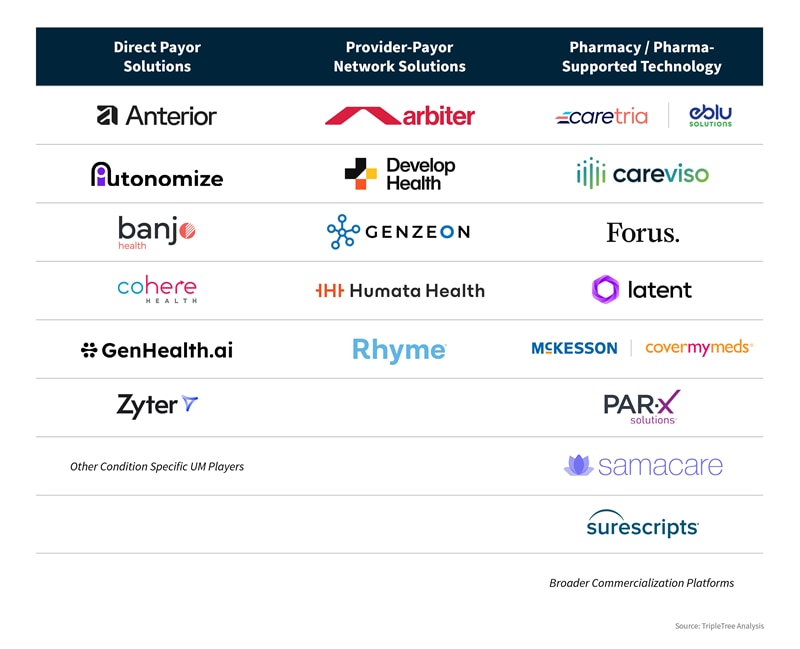
Representative Companies Addressing Prior Authorization Pain Points
Notes:
Categorization across payer and provider solutions is determined based on the paying end customer. In both cases, these represent network solutions that connect both payers and providers.
Payers are internally investing heavily in product development. Large revenue cycle clearinghouses like Waystar, FinThrive, and R1 RCM are well positioned to support the provider-payer network given existing infrastructure between the stakeholders. Many of the solutions provided above are addressing multiple verticals across payer, provider, and pharmacy, with many backed and supported by pharma manufacturers or broader pharma commercialization platforms.
Future Outlook
The industry is at a pivotal moment as the long-standing friction of prior authorization gives way to a modernized, tech-enabled future. By integrating real-time adjudication capabilities and AI-powered operational tools, the industry is moving toward a system that prioritizes transparency and patient access. These advancements, further enforced and accelerated by federal mandates, represent a fundamental shift in how care is authorized and delivered. Ultimately, the transition to automated workflows is essential to reducing clinician burnout and ensuring patients receive timely, affordable, and evidence-based care.
At TripleTree, we’ll continue to provide insights on market-leading trends and conversations that are shaping healthcare. Read more about what’s transforming the healthcare landscape in previous TripleTree publications or reach out for more information.