Introduction: The Evolution of Outpatient Care
Behavioral health operators are facing a new challenge: balancing growing patient volume with a rising need for high-acuity, specialized care. While traditional talk therapy and standard medication management remain a highly effective foundation for outpatient care, the industry is evolving toward an integrated, multi-modality approach.
Faced with a rising clinical acuity, forward-thinking behavioral health platforms are adapting their service models. Rather than replacing their therapeutic core, innovative providers are integrating advanced interventional therapies, such as transcranial magnetic stimulation (TMS), esketamine (Spravato) and the potential of psilocybin, to deliver a more comprehensive, patient-centric continuum of care for high-acuity patients. This multi-modality approach allows providers to effectively treat populations with treatment-resistant depression (TRD) while simultaneously building highly scalable, recurring revenue streams.
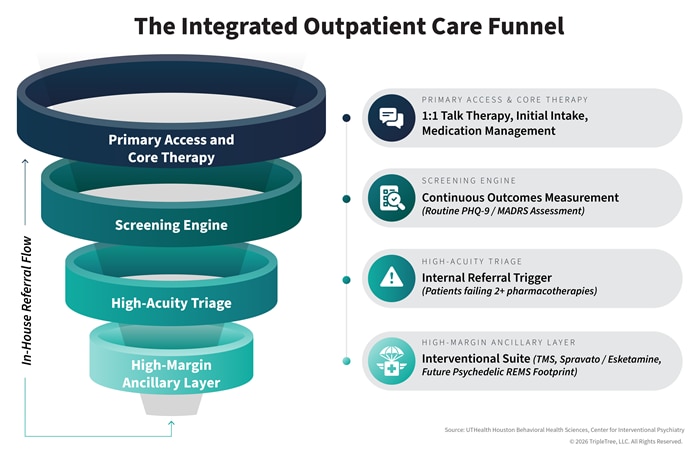
While traditional talk therapy remains the foundation of care, the most successful platforms are bringing these advanced treatments under the same roof as foundational psychology.
The Clinical Case for Precision Interventional Care
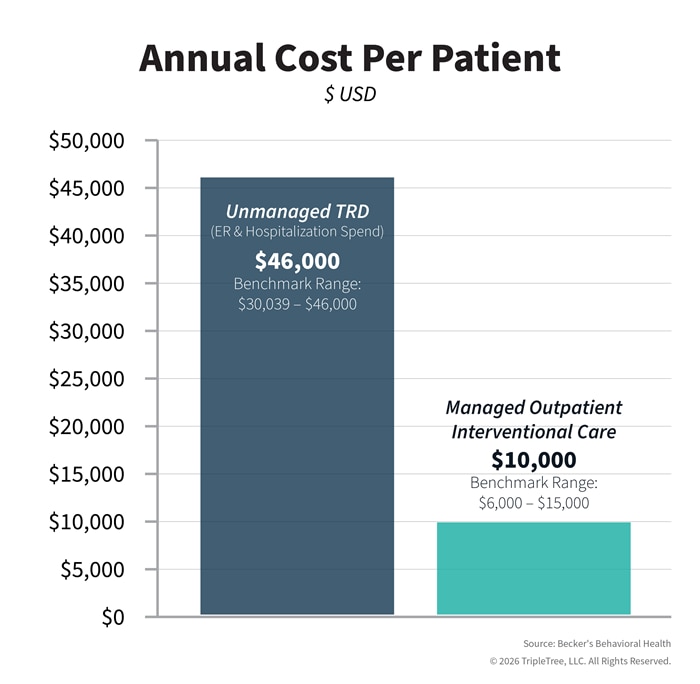
Traditional antidepressants help many patients, but they often fall short when it comes to severe depression. The STAR*D trial highlighted this reality, showing that standard SSRIs only bring about 28% of patients into full remission, from a report on Psychiatry Online. When those initial treatments fail, the odds of success decline to roughly 7% by a patient's third or fourth try. Once someone has tried and failed two or more medications, they are officially diagnosed with Treatment-Resistant Depression (TRD). Beyond the devastating personal toll, TRD is a massive systemic issue, costing the U.S. economy $44 billion every year in medical expenses, lost productivity, and emergency room visits, as noted by MDPI.
To bridge this gap, outpatient providers are scaling three core interventional modalities:
- Transcranial Magnetic Stimulation (TMS): A non-invasive neuromodulation therapy utilizing magnetic pulses to stimulate mood-regulating brain circuits. Breakthroughs like the fMRI-guided SAINT protocol condense a standard six-week program into five days of accelerated sessions, yielding remission rates between 78% and 90% according to a report from the American Journal of Psychiatry.
- Glutamatergic Treatments (Spravato / Esketamine): FDA-approved intranasal esketamine delivers rapid relief from severe depressive symptoms and acute suicidal ideation in as little as 24 hours. The six-year SUSTAIN-3 trial supported its long-term safety, giving operators the confidence to build resolute, permanent observation suites.
- The Psilocybin Horizon: Late-stage clinical trials evaluating synthetic psilocybin demonstrate strong potential to break negative thought loops in TRD patients. Premier operators recognize that the physical infrastructure and Risk Evaluation and Mitigation Strategy (REMS) compliance protocols built today for Spravato may represent the operational blueprint required for future commercial psilocybin administration.
Breaking Down Payer and Regulatory Barriers
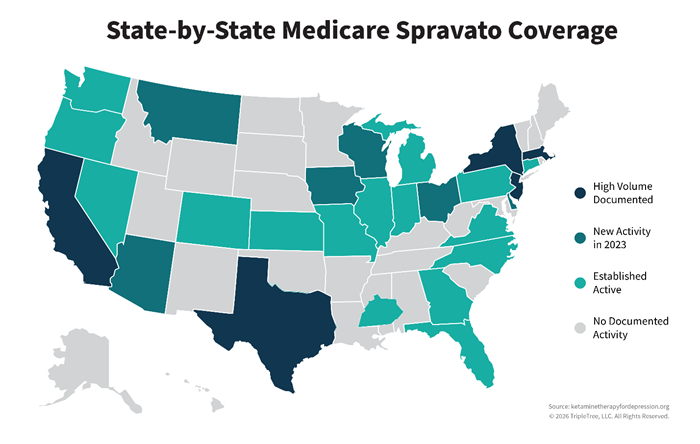
The key driver pushing interventional therapy into the mainstream market is the shift in reimbursement. Commercial payers and Medicare are lowering the hurdles, standardizing what they cover, and making the prior authorization process smoother.
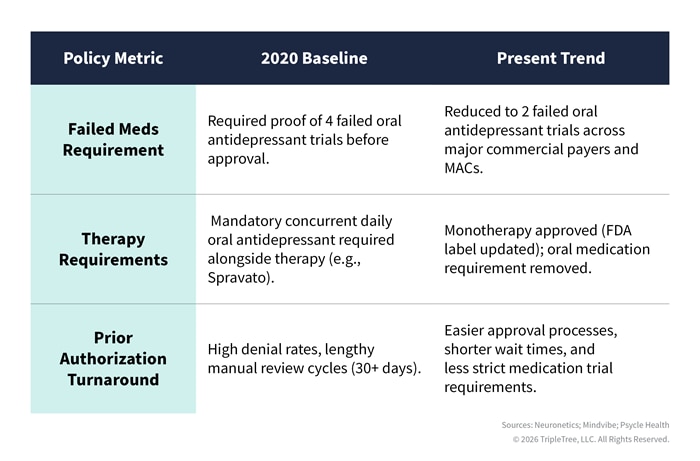
Key catalyst trends across the payer landscape include:
- Medical Necessity Recognition: Major commercial health plans, including UnitedHealthcare, Aetna, and Cigna, now explicitly categorize TMS and Spravato as medically necessary treatments rather than elective, out-of-pocket luxuries.
- Expanding In-Network Contracting: According to a report by Osmind, payers are actively bringing interventional providers in-network to reduce total cost of care, recognizing that outpatient interventional therapy prevents high-cost inpatient stays and ER readmissions.
- Reimbursement Rate Stability: Medicare fee schedules and commercial contracts have established predictable CPT coding paths for both technician delivery (TMS) and extended post-administration monitoring.
The M&A Outlook and Platform Economics
Understanding Market Trends and The Balanced Strategy
Large healthcare systems and strategic buyers are increasingly shifting their focus toward high-precision interventional treatments. LifeStance Health recently cited expanding interventional psychiatry as a top priority driving their 2027 geographic expansion plans. By balancing these advanced treatments with foundational traditional therapy, providers establish a comprehensive, integrated continuum of care.
Within this model, recurring treatment schedules and clear reimbursement guidelines not only ensure consistent clinical engagement, but also create highly predictable revenue streams. For investors evaluating these platforms, the overarching thesis centers on identifying the operational metrics that facilitate seamless patient transitions across the care spectrum, and navigating the regulatory frameworks required to safely scale these integrated clinical models.
Value Creation for Providers Offering Interventional Therapy
For providers, expanding into interventional therapy unlocks operational and strategic advantages that elevate the overall platform:
- Higher Patient Lifetime Value: Because Spravato and TMS protocols require regular sessions spanning six months and six to nine weeks, respectively, they drive much stronger patient retention than standard medication management (source, source).
- Driving Utilization of Labor and Space: Decoupling revenue from time allows clinics to maximize utilization per chair and per room. Models featuring technician-delivered TMS alongside a single prescriber monitoring multiple Spravato rooms optimize revenue per square foot (source).
- Referral Capture: An integrated funnel allows traditional therapists to refer high-acuity patients in-house, resulting in lower Customer Acquisition Costs (CAC) and higher conversion rates (source).
- Payer Relations: Operating primarily in-network is highly advantageous for platforms seeking to scale patient access. Building on that foundation, providers that track and demonstrate favorable clinical outcomes (e.g., PHQ-9 and MADRS scores) can use that proven efficacy as a powerful lever during rate negotiations and payer contracting (source).
- Spravato and TMS Service Line Extensibility: The specialized, REMS-certified physical footprints currently being built for Spravato and TMS can be extended to future FDA-approved modalities, such as synthetic psilocybin (source, souce).
- Proven Growth Playbooks: Establishing these high-margin therapies enables providers to build repeatable de novo site selection playbooks with highly predictable operational ramps, accelerating sustainable expansion (source).
What Buyers Diligence
During an M&A process, buyers and private equity sponsors execute detailed diligence specifically tailored to the nuances of interventional psychiatry. Key focus areas include:
- Payer Contracting and Relations: Analyzing payer mix, historical rate durability, and the specific prior authorization and denial rates across payers.
- Spravato Drug Economics: Evaluating the spread in buy-and-bill models versus relying on specialty pharmacies, alongside inventory holding costs, distributor rebates, and the systemic risk of single-drug concentration.
- Referral Diversity: Evaluating both internal and external referral networks to ensure sustainable patient volume and avoid concentration risk.
- Treatment Protocols: Tracking course completion versus early drop-off rates, as well as maintenance and re-treatment rates. While long-term maintenance drives LTV, payers heavily scrutinize patients who receive repeated treatment beyond standard clinical baselines.
- Compliance: Strict auditing of medical coding practices and adherence to Spravato REMS compliance and monitoring protocols.
- Clinician Retention: Validating that a strong, supportive culture is in place to maintain the stability of the clinical workforce.
- Growth Profile: Demonstrating multi-modal growth capabilities through a proven record of driving both same-store expansion and successful de novo launches.
Market Activity and Platforms to Watch
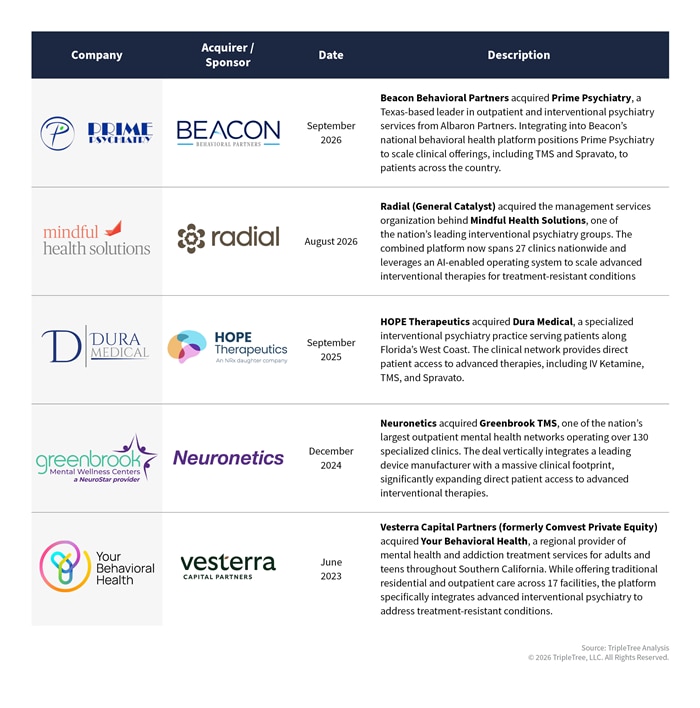
Consolidation across the behavioral health sector remains active, with sponsors favoring platforms capable of scaling interventional capabilities alongside core therapy models. The M&A market continues to see notable activity surrounding platforms capable of scaling interventional service lines alongside comprehensive care models.
Recent Notable Trades
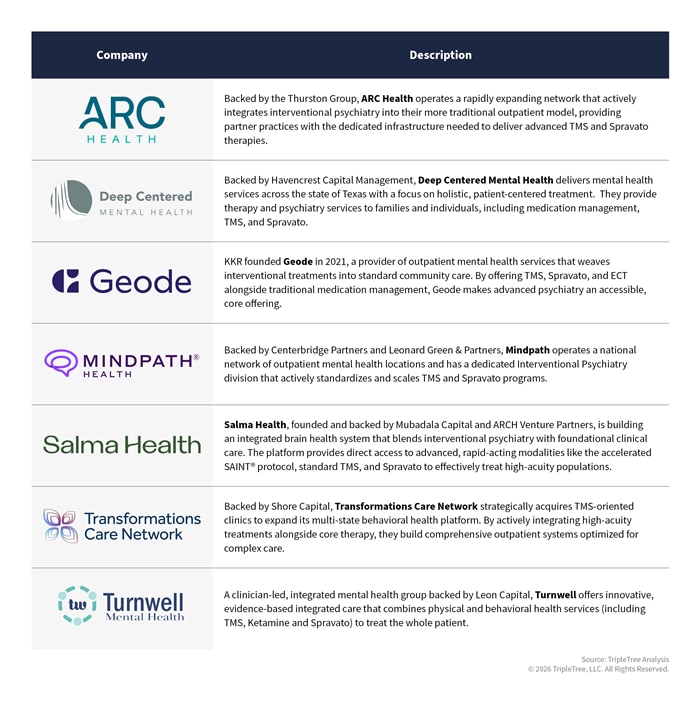
Other Transformative Companies to Monitor Going Forward
TripleTree’s Perspectives
The outpatient behavioral health landscape is undergoing a structural inflection. The integration of interventional psychiatry does not displace traditional therapy; rather, it elevates the entire continuum of care. By pairing core psychological services with precision, high-margin modalities such as TMS and Spravato, outpatient providers can treat high-acuity populations effectively while achieving enhanced unit economics and decoupling revenue from provider time constraints.
With payer coverage expanding and new therapeutics on the horizon, the platforms that will win market share over the next five years are the ones building specialized interventional infrastructure and integrated referral networks today.