
The pharma data and analytics landscape is undergoing a massive shift. Navigating today's market is no longer just about tracking broad volume; it is about uncovering highly specific, differentiated insights. In fact, according to a joint report by ZS and Reuters, 57% of pharma leaders cite a "lack of differentiated insights" as their primary barrier to commercial success.
To overcome this friction, the industry is increasingly relying on connected data networks that tie together health systems, pharmacies, and providers. This structural shift is being driven by five macro trends reshaping the entire commercial and clinical value chain.
The 5 Trends Redefining Pharma Data & Analytics
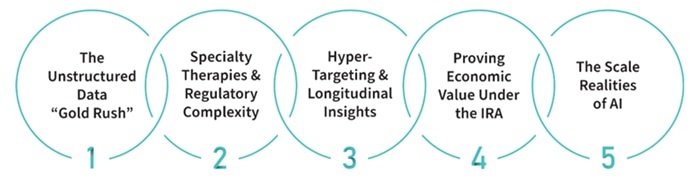
1. The Unstructured Data "Gold Rush"
The industry is experiencing a rapid proliferation of data, yet a critical gap remains in the ability to turn this "new oil" into actionable insights. Clinical trials are growing exponentially more complex, with an average of 6 million data points generated per Phase III trial - a 67% increase since 2020. To unlock new pathways for commercial and clinical decision-making, the market is shifting toward scaled network solutions that connect key constituents to capture unique, longitudinal datasets.
2. Specialty Therapies & Regulatory Complexity
The drug development pipeline has shifted fundamentally, with specialty drugs now making up 75% of the total pipeline. While less than 2% of the patient population utilizes these complex therapies, they account for a staggering 50% of total pharmacy spend. Treating these highly complex disease states and niche patient populations requires specialized, data-driven commercialization models rather than traditional, broad-brush market approaches.
3. Hyper-Targeting and Longitudinal Insights
Pharma is moving away from traditional market sizing and embracing individualized, longitudinal patient profiling to drive commercial efficiency. Because specialty therapies target exceptionally specific populations, companies are leveraging patient-specific real-world data (RWD) and real-world evidence (RWE). This allows commercial teams to identify highly niche patient cohorts and pinpoint the exact healthcare providers (HCPs) treating them.
4. Proving Economic Value Under the IRA
The Inflation Reduction Act (IRA) and tightening payer demands have shifted the competitive landscape from pure clinical efficacy to strict economic value. To substantiate pricing and defend market access, pharma companies must now synthesize massive, outcomes-based datasets. This pressure is heavily accelerating data needs across the entire product lifecycle, forcing organizations to build robust economic dossiers as early as Phase IIA.
5. The Scale Realities of AI
While Artificial Intelligence (AI) promises massive advancements for internal efficiencies and analytics, widespread adoption faces severe data limitations. Today, 95% of AI proofs of concept in life sciences fail to scale, primarily due to fragmented datasets and weak underlying data foundations. Consequently, pharma buyers are looking past the hype to prioritize trusted vendors who can solve foundational data ingestion, cleansing, and interoperability.
Ultimately, the modern pharma data and analytics landscape is moving away from generic, "one-size-fits-all" approaches in favor of high-fidelity, interconnected ecosystems. Whether responding to regulatory pressures like the IRA or trying to scale the next generation of AI analytics, success hinges on a robust and clean data foundation. As specialty therapies continue to dominate the pipeline, the organizations that prioritize trusted partners, longitudinal patient profiling, and robust real-world evidence will be the ones that effectively bridge the gap between raw data and commercial impact.
If you are interested in learning more about the sector, exploring opportunities in market, or considering alternatives for existing investments, the TripleTree team would be happy to share our perspectives along with our broader content on the data and analytics landscape. Contact us today.