
The U.S. healthcare system's well-documented struggle with escalating costs and fragmented care delivery continues to propel the fundamental and urgent shift from the legacy Fee-for-Service (FFS) model toward Value-Based Care (VBC). This transition is accelerated by the convergence of intensified payer consolidation and the critical demand from large, integrated health systems for next-generation tools to manage population health, increasing the financial imperative for providers to participate in risk-sharing arrangements.
VBC is an economic realignment that ties provider reimbursement to the achievement of measurable quality, efficiency, and equity outcomes. Integral to VBC is robust Population Health Management (PHM), which moves beyond episodic treatment to proactively manage the health of defined patient groups. Success in advanced VBC contracts, such as Medicare Advantage, ACOs, and capitated models, is directly proportional to an organization's capability to execute a scalable PHM strategy powered by advanced technology for risk stratification, preventive care, and seamless care coordination. The evolving market dynamics reflect this reality, focusing intense capital investment on technological enablers that facilitate this complex transition.
Themes Driving VBC Technology Investment
Given the rapid evolution and demand for best-in-class third party solutions, there has been significant investor activity in the space, with a few dominant strategic themes driving activity.
The need for providers and payers to manage data better for operational success has been a critical theme across the market. For VBC to be profitable and scalable, providers and payers alike must evolve from passive data users to active data managers who embed intelligence into care delivery and population management workflows; this will require a technology-focused approach to inject data insights directly into the clinical and administrative stream, ensuring organizations are equipped to manage patient panels, optimize coding for risk adjustment (a critical financial lever), and close quality gaps efficiently and at scale.
The need to better manage data at scale only furthers the criticality of data interoperability and predictive analytics. Success in VBC is impossible without real-time, comprehensive, and actionable data that unifies clinical electronic health records (EHR), claims, pharmacy, and Social Determinants of Health (SDoH) information. This necessity has made platforms that focus on data aggregation, interoperability, and AI-driven predictive analytics highly attractive, as data fluency is the key to identifying and managing at-risk populations and unlocking the economic promise of VBC.
Lastly, as complexity in payments increases, companies that can help streamline VBC Payment Mechanisms and Technology Integration are in high demand. The industry requires highly specialized platforms to manage the financial complexity of risk-based contracts, including performance calculation, benchmarking, and quality measure reporting. Technology integration that can seamlessly handle the transition from FFS claims to VBC payment models (capitation, shared savings) remains a high priority for investors, driving demand for analytic and operating system solutions. Successful platforms must be versatile enough to manage payment reconciliation across various payer contracts and regulatory models (e.g., Medicare, Medicaid, and Commercial ACOs), ensuring financial compliance and maximizing contract revenue.
The VBC market is a strategic growth area that has moved well past its nascent stage and is now fundamental to the financial and clinicial success of healthcare organizations. Our observations underscore key structural shifts:
- Successful execution of VBC requires sophisticated, scalable technology
- Tech-enabled service platforms (tech is the VBC enabler) must be capable of managing clinical, operational, and financial complexity for payer and providers
|
Advantmed, a healthcare information management company, provides clinical and financial performance tools used by health plans and providers to drive accurate risk documentation and optimize quality outcomes in risk-based models. Advantmed was recapitalized in February 2025 by Webster Equity Partners. |
 |
|
Arcadia, a healthcare data analytics platform, curates various data types from across the healthcare ecosystem to provide insights for patient risk assessment and care management. Arcadia announced a strategic partnership with Nordic Capital in July 2025. |
 |
|
Cozeva, a SaaS platform for VBC enablement, focuses on unifying disparate data and streamlining population health management. Cozeva recently merged in October 2025 with Vatica Health, a Frazier Healthcare Partners-backed company that offers provider-centric, prospective risk and clinical quality solutions to create a comprehensive platform for payers and providers to engage in a comprehensive and unified operating system for value-based care. |
 |
|
Cedar Gate, a provider of underlying analytics, enables providers, payers, and employers to manage and evaluate performance within value-based care contracts. Cedar Gate, initially founded in partnership with GTCR, was acquired by IQVIA, a global provider of clinical research services and healthcare intelligence, in October 2025. |
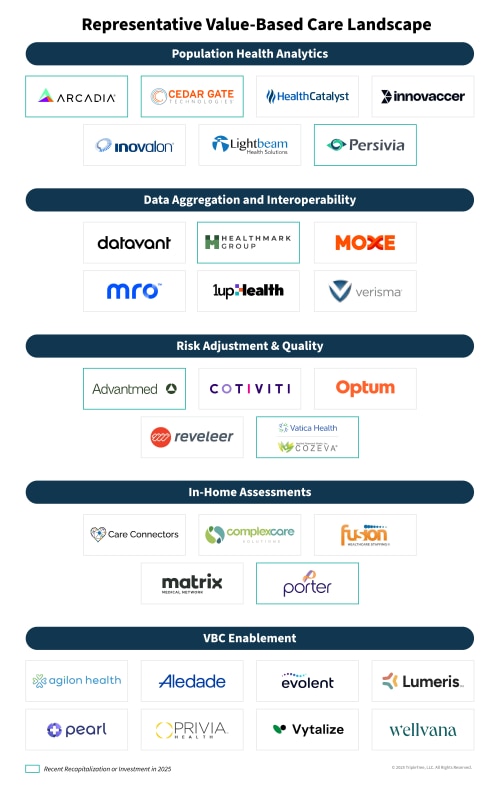
As technology rapidly advances to meet a transformational trend in VBC, the market is poised to look to companies that can provide scale and sophisticated solutions, addressing the ever-growing challenges of PHM.
At TripleTree, we’ll continue to provide insights on market-leading trends and conversations that are shaping healthcare. Read more about what’s transforming the healthcare landscape in previous TripleTree publications or reach out for more information.